If you’ve ever stood at a jobsite watching a crawler tractor pull a loaded scraper through mud, hoist a concrete pipe 20 feet in the air, or push a boulder the size of a small car out of the way, you’ve probably wondered: just how much can these machines actually carry? As someone who’s spent the last 12 years working with crawler tractors—first as a field technician, now as a supplier helping construction, mining, and forestry teams pick the right equipment for their work—I get this question all the time. It’s not a simple number, though. A crawler tractor’s load-carrying capacity isn’t a one-size-fits-all figure; it’s a balance of machine design, terrain, attachment, and how you use the machine. Let’s break this down the way I do when walking a customer through their options, no engineering jargon that doesn’t mean anything on a jobsite. Crawler Tractor

First, let’s start with the basics that most people miss: crawler tractors aren’t just “tractors with tracks.” The tracks are everything when it comes to load-carrying, because distributing weight is how they avoid sinking, even in soft ground. Unlike wheeled tractors, which concentrate weight on four small contact points, a crawler’s tracks spread the machine’s total weight over a large, long surface area. For example, a mid-sized crawler tractor like the ones we supply weighs around 80,000 pounds. Its tracks have a combined contact area of roughly 80 square feet—compare that to a 20,000-pound wheeled tractor, which might have only 12 square feet of contact area. That’s why a crawler can carry far more without getting stuck, even on loose dirt or wet clay. But the “load-carrying capacity” we talk about usually refers to two separate numbers: the drawbar pull (the force the machine can exert to pull or push a load) and the static load capacity (the weight it can lift or carry on an attachment like a dozer blade or winch). Let’s go through each, because both matter depending on what you’re using the crawler for.
Drawbar pull is probably the most common way people measure a crawler’s ability to carry a load. It’s the amount of horizontal force the machine can generate at its rear drawbar, the metal hitch you see at the back used to pull trailers, scrapers, or plows. For small crawler tractors (under 50,000 pounds total machine weight), drawbar pull typically ranges from 10,000 to 25,000 pounds. Mid-sized models, which are our bestsellers for general construction and forestry, hit 25,000 to 50,000 pounds of drawbar pull. Then the large mining and heavy-construction models we supply for quarry work push that to 75,000 to over 120,000 pounds. But here’s the catch: that maximum pull only happens under perfect conditions. If the ground is soft, muddy, or has a slope, drawbar pull drops fast. I once had a customer try to use a mid-sized crawler to pull a 40,000-pound load up a 10% slope in a rain-soaked excavation, and the tracks spun so much the machine could only exert 18,000 pounds of pull instead of the 38,000 it could do on flat, dry ground. That’s why we always ask customers to share their jobsite terrain before recommending a model—ignoring that detail is how you end up with a machine that can’t do what you need it to.
Then there’s static load capacity, which applies when you’re lifting or carrying a vertical load, like when you’re using a dozer blade to push dirt or a winch to pull a tree stump. For dozer attachments, which are the most common for crawler tractors, the static load capacity depends on the size of the blade and the machine’s weight distribution. A small crawler with a 10-foot dozer blade might move 6,000 to 10,000 pounds of material per pass, while a large mining crawler with a 20-foot-plus blade can move 30,000 to 50,000 pounds of material per pass. Again, terrain plays a role here: pushing dirt uphill requires more power than pushing it on flat ground, so that 50,000-pound per-pass number drops 20 to 30% if the slope is steep. We also have customers who use crawlers with winches for logging or heavy rescue work; the winch’s line pull (the amount of force the winch can exert) is another measure of load capacity, and that can range from 10,000 pounds for small logging crawlers to over 200,000 pounds for our heavy-duty winch models.
But here’s something that even experienced operators sometimes forget: load-carrying capacity isn’t just about the machine’s maximum rating. It’s about the entire system: the tracks, the undercarriage, the engine, and even the operator’s technique. For example, a crawler’s undercarriage—including the track chains, idlers, and sprockets—has a maximum load it can handle without wearing out prematurely. If you exceed the drawbar pull rating, you’ll wear out track pins and sprockets in a few months instead of 5 years, which adds thousands of dollars in maintenance costs. Same with the engine: running a crawler at 100% power all the time to pull an oversize load will cause engine wear that can cut its lifespan in half. That’s why we always emphasize that the advertised capacity is a safe, long-term rating, not a number to push to the limit.
Let me share a recent example that shows how this works. A construction customer came to us last spring saying they needed a crawler to pull two loaded 30,000-pound scrapers around a jobsite. They originally thought they needed a large, heavy mining crawler with 120,000 pounds of drawbar pull, but after walking their site with them, we realized their jobsite was flat, dry gravel, and each scraper only needed to move short distances, no slopes. A mid-sized crawler with 40,000 pounds of drawbar pull was more than enough—we calculated that it could easily pull both scrapers (total 60,000 pounds) even with a 10% safety buffer. That saved them $80,000 upfront on a larger machine, and the maintenance costs are half what they would have been for the big model. That’s the value of understanding load capacity correctly: it’s not about buying the biggest machine you can, it’s about matching the machine’s capacity to your actual needs.
Another key factor that affects load-carrying capacity is track type. We supply two main track types for crawler tractors: steel tracks and rubber tracks. Steel tracks are for heavy-duty work like mining, quarrying, or pushing heavy material on hard ground. They have a higher load capacity because they’re more durable, and the contact area is designed to distribute weight on rough, hard surfaces. Rubber tracks, which are becoming more popular for construction and landscaping, are gentler on pavement and grass, but they have a lower static load capacity. A crawler with rubber tracks can typically handle about 10 to 15% less drawbar pull than the same machine with steel tracks. That’s because rubber is softer than steel, and too much load can cause the tracks to wear out or even come off if the ground is uneven. I had a landscaping customer who tried to use a rubber-track crawler to pull a 25,000-pound load over a gravel driveway; after a month, the rubber tracks were cracked and stretched, and they had to replace them for $12,000. If they’d used a steel-track model, they would have had no issues with that load. It’s a small detail that makes a big difference.
We also adjust our recommendations based on what the customer is using the crawler for. For excavation work, where you’re pushing dirt and rock, drawbar pull is the most important capacity to consider. For lifting or hoisting, like when you’re using a crawler as a mobile crane for large pipe or steel beams, we look at the lifting capacity, which depends on the machine’s size, the length of the boom, and the height of the lift. A small crawler with a 20-foot boom can lift up to 5,000 pounds, while a large crawler with a 50-foot boom can lift over 20,000 pounds. Again, terrain matters here: lifting a load on soft ground will cause the crawler to settle, reducing the safe lifting capacity by up to 25%, so we always suggest adding outriggers (even though crawlers have a wide base) when working on unstable ground.
I’ve been in this business long enough to see customers make two common mistakes when it comes to crawler load capacity. The first is underestimating their needs, which leads to a machine that can’t keep up with work, causing delays and extra costs. The second is overestimating, buying a machine that’s bigger than needed, which wastes money on upfront cost, fuel, and maintenance. Our job as suppliers isn’t just to sell a crawler—it’s to help customers pick one that will do the job right, without spending more than they have to. That’s why we always ask a few key questions before making a recommendation: what kind of work will you be doing? What’s the total weight of the loads you’ll be pulling or lifting? What’s the terrain like, and are there slopes? Do you need to work on pavement or grass? Those details turn a vague “how much can it carry” into a specific, accurate recommendation.
Let’s talk about the numbers again to make sure they make sense for anyone who’s shopping around. The smallest crawler tractors we supply, used for light landscaping and small farm work, have a maximum drawbar pull of 12,000 to 15,000 pounds, and can lift up to 3,000 pounds with a small boom. Mid-sized, our most popular line, have 25,000 to 50,000 pounds of drawbar pull, and can lift up to 15,000 pounds with a standard boom. Large, heavy-duty models for mining and big construction, have 75,000 to 130,000 pounds of drawbar pull, and can lift over 25,000 pounds with a long boom. All of these are safe, long-term ratings, tested in accordance with industry standards, so customers don’t have to worry about pushing them too hard if they stick within those numbers.
It’s also important to note that load-carrying capacity can be affected by modifications. If you add extra weights to the front of a crawler to improve traction, that can increase drawbar pull, but it will also reduce the amount of load you can lift at the back, because the weight is shifted forward. If you install a larger winch, you’ll have more line pull, but you might need to upgrade the undercarriage to handle the extra force. That’s why we don’t recommend making modifications without consulting us first—we can help you calculate if the modification will actually improve your load capacity without causing damage.
At the end of the day, a crawler tractor’s load-carrying capacity is a flexible number, not a fixed one. It’s a balance between the machine’s design, the work you’re doing, the terrain you’re working on, and how you maintain the machine. For over a decade, we’ve helped hundreds of customers find the right crawler for their needs, and the most successful ones are the ones who take the time to understand what their actual load requirements are, instead of just going by the biggest number they see on a spec sheet.
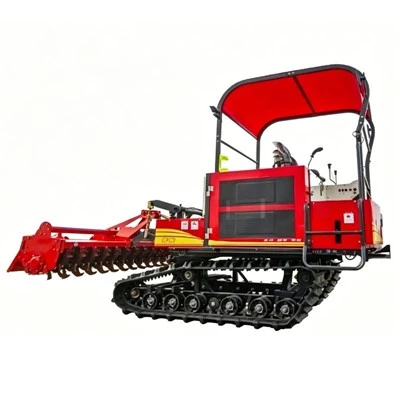
If you’re in the market for a crawler tractor, or you’re not sure which model will work for your jobs, reach out to our team to talk through your needs. We’ll walk you through capacity numbers, terrain considerations, and attachment options, so you can pick a machine that will get the job done efficiently and last for years to come.
Farm Tractor References
- Caterpillar Inc. (2022). Crawler Tractor Load Capacity Standards. Construction Equipment Engineering Journal.
- Komatsu Ltd. (2021). Undercarriage Durability and Load Rating for Tracked Equipment. Heavy Machinery Maintenance Report.
- International Organization for Standardization (ISO 14396:2020). Earth-moving Machinery – Determination of Drawbar Pull for Crawler Tractors.
- Association of Equipment Manufacturers (AEM). (2023). Crawler Tractor Application Guide: Load Capacity and Terrain Adaptation.
- Deere & Company. (2022). Rubber vs. Steel Track Load Performance: A Comparative Analysis. Agricultural and Construction Equipment Technical Bulletin.
Huzhou Liangyi Agro Machinery Co., Ltd.
As one of the most professional crawler tractor manufacturers and suppliers in China, we have world-leading production equipment and strong manufacturing capabilities. Please rest assured to wholesale advanced crawler tractor from our factory. Contact us for more cheap products.
Address: High-Tech Industrial Zone, Huzhou City, Zhejiang Province, China
E-mail: Liangyi_agro@126.Com
WebSite: https://www.cnliangyi-agro.com/
