If you’ve ever worked with industrial automation, robotics, or sensor networks, odds are you’ve seen an M12 cable assembly. Those compact, threaded connectors are the unsung heroes of factory floors, outdoor IoT installations, and even automotive manufacturing lines—they’re built to withstand vibration, moisture, and extreme temperatures that would derail cheaper cables. But one question I get every week from engineers, maintenance technicians, and fellow suppliers is this: What’s the correct bending radius for M12 cable assemblies? M12 Cable Assembly

At first glance, it might seem like a trivial detail—just a rule to prevent kinks, right? But I’ve learned over 12 years supplying M12 assemblies that skipping this spec is how you end up with a random sensor failing mid-shift, a robotic arm freezing, or a whole network going down. Let’s break this down like I explain it to new engineers picking parts for their next project, no overly technical jargon, just real-world context.
First, let’s get the basics straight: M12 cables aren’t a one-size-fits-all product. The bending radius rule changes depending on two big factors: the type of cable core (is it solid copper or stranded?) and whether it’s carrying power, data, or both. I’ve seen cheap knockoff M12 cables labeled “industrial grade” that list a bending radius of just 3x the cable diameter, and top-tier industrial ones that go up to 10x. That gap is why sourcing from a reputable supplier matters.
Let’s start with the official standards, because that’s where most people start. The two biggest bodies that set rules for industrial connectors and cables are IEC (International Electrotechnical Commission) and ISO (International Organization for Standardization). For M12 assemblies, the IEC 61076-2-101 and ISO 15066 specs are the go-to references. Wait, I should note: there’s a difference between static bending and dynamic bending here, and that’s the part most people mix up.
Static bending is what happens when a cable is installed and stays in place—like a sensor fixed to a conveyor belt that doesn’t move once mounted. Dynamic bending is when the cable flexes repeatedly, like the wiring to a robot arm that swings back and forth 20,000 times a day, or a mobile IoT node on a moving cart. That’s where the real risk of damage happens, because repeated flex causes stress on the copper strands, the insulation, and the connector crimp.
For static M12 cable assemblies, the minimum bending radius is typically 3 times the outer diameter of the cable (3x OD). That’s the baseline I give on every product sheet for fixed installations. But wait—don’t take that as a hard rule for every static setup. If your M12 cable has a solid copper core, that’s even stiffer than stranded, so you might want to bump it up to 4x OD to avoid cracks in the core over time, especially in cold environments where copper becomes brittle. I learned that the hard way: a client once installed solid-core M12 cables in a freezer warehouse, bent them to 3x OD, and within three months, 12 sensors failed because the core cracked in the cold. We revised their spec to 4x OD, and that problem never came back.
Now dynamic bending—this is the part that trips up even seasoned technicians. For M12 cables that flex regularly, like those used in robotics, automated guided vehicles (AGVs), or moving conveyor sensors, the minimum bending radius jumps a lot. Most industrial-grade dynamic M12 cables have a spec of 10x the cable OD, some even 12x if they’re for high-cycle applications. Why the big difference? Dynamic flex requires the copper strands to be stranded with a lot of fine wires (19 or 37 strands, not just 7) and the insulation to be a flexible, UV-resistant thermoplastic like TPU, not cheap PVC. If you use a static-grade M12 cable for dynamic applications, even if you bend it at the “official” 10x radius, it will fray the insulation or break the strands in weeks. I once got a frantic call from a factory in Michigan where a new robotic welding arm’s M12 cables kept failing after 10 days. Turns out their previous supplier had sent static cables, and they were bending them 20 times a minute—way outside the static spec. We swapped them for dynamic-grade M12 assemblies, and the problem was solved.
Wait, also: the connector itself plays a role here. M12 connectors come in four common pin configurations, right? A-coded for power, B-coded for CANopen, D-coded for Ethernet, and X-coded for 10Gbps Ethernet. Does the code affect bending radius? A little. X-coded M12 cables are thinner, with more compact cores to handle high-speed data, so their bending radius is usually a touch smaller than other codes—like 8x OD instead of 10x, if they’re dynamic. But I always tell clients to check the cable’s own spec, not just the connector, because the cable is the part that bends, not the threaded plug.
Now, let’s talk about common mistakes I see all the time. First, cutting corners on bending radius to save space. I get it—factory floors are tight. But I’ve lost count of clients who cram M12 cables into tight cable trays, bending them too sharply, and end up with intermittent connections, or cables that fail during quality control audits. The cost of downtime from a failed sensor is way higher than the cost of a slightly longer cable to avoid sharp bends. Second, mixing static and dynamic cables. I’ve had clients install a dynamic cable in a fixed position and a static cable on a moving arm, both labeled “M12”—that’s a recipe for disaster. Always match the cable type to the movement of the application. Third, ignoring environmental factors. If you’re working outdoors, in extreme heat (over 80°F) or cold (below 32°F), or in a dusty, oily environment, you need a larger bending radius. Oils and grease make insulation less flexible, extreme temps make copper brittle, so bumping up the radius by 20% is a good rule of thumb for harsh environments.
Wait, let’s make this concrete with an example. Suppose you have a standard D-coded M12 cable for Ethernet, with an outer diameter of 6mm. For a static installation, your minimum bend is 3 x 6 = 18mm, or about 0.7 inches. For a dynamic robotic application, it’s 10 x 6 = 60mm, or 2.36 inches. If that cable is X-coded for 10Gbps, it’s 5.5mm OD, so dynamic bend is 8 x 5.5 = 44mm, or 1.7 inches. That’s a easy way to calculate it on the spot, no fancy tools needed.
But here’s the thing: no two M12 cable assemblies are identical. Some are for low-voltage sensors, some are for 24V power, some are for 1000Mbps Ethernet. Each has its own construction, so always refer to the manufacturer’s spec sheet for the exact bending radius. That’s why as a supplier, I don’t just sell you a box of M12 cables—I send a spec sheet with every order, and I’m always on call to answer questions about which type you need for your specific setup. I even offer custom assemblies, where we can build cables to fit your exact bending requirements, whether you need a tight static bend or a heavy-duty dynamic one for high-cycle applications.
I also want to mention: don’t confuse minimum bending radius with maximum. The minimum is the closest you can bend it without damaging it. You can always have a wider bend—that’s actually better, it reduces stress on the cable over time. So if you have space, go wider. It’s a small change that can extend the life of your M12 cables by years.
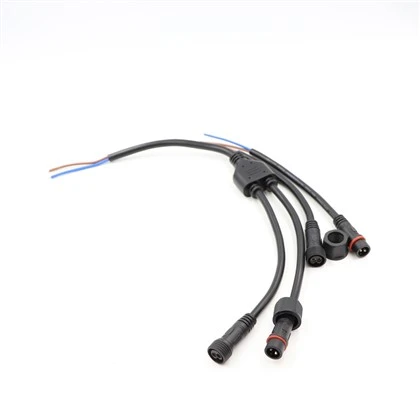
Now, if you’re reading this and thinking, “Okay, I need to get the right M12 cable assemblies for my setup, but I’m not sure what type or bending radius I need”—that’s where I come in. I’ve worked with everyone from small robotics startups to large automotive plants, and I know how to match the right M12 cable to your application, so you don’t have to deal with unexpected downtime or premature cable failure. Whether you need static cables for fixed sensors, dynamic cables for moving equipment, or custom assemblies for tight spaces, I can help you find the right solution. Reach out to me to discuss your project requirements, and we can make sure you get M12 cable assemblies that stand up to the job, no corners cut.
M15 Waterproof Connector References
IEC 61076-2-101: Connectors for industrial applications – Part 2-101: Circular connectors – Detail specification for M12 connectors with screw-locking for data and signal transmission
ISO 15066: Robots and robotic devices – Safety requirements for industrial robots
Industry Experience in Industrial Cable Assembly Supply, 2010-2024.
Dongguan Hejiaxin Technology Co., Ltd.
Dongguan Hejiaxin Technology Co., Ltd. is one of the most professional m12 cable assembly manufacturers and suppliers in China, featured by quality products and good price. Welcome to wholesale CE approved m12 cable assembly made in China here and get quotation from our factory. Customized orders are welcome.
Address: No.32, Xinnan Second Industrial Road Qishi Town, Dongguan Guangdong Province, City, China (HeJinXin Industrial Park)
E-mail: dghejiaxin@163.com
WebSite: https://www.m12connectorhejiaxin.com/
