If you’re working in metal fabrication, construction, or automotive manufacturing, chances are you’ve heard the terms “roll forming” and “press braking” tossed around when talking about profile production. But for someone like me—who’s spent 12 years selling profile roll forming machines to fabricators, builders, and product designers—the most common question I still get isn’t just how each process works—it’s when to choose one over the other. Last month, a structural steel engineer called me in a panic: his team had pressed 500 C-channel profiles for a commercial roof frame, and half of them had cracked right at the bend radius. He’d never worked with roll formed profiles before, and he had a 10-day deadline to fix the issue. That call made it clear: too many buyers only know the surface difference between these two methods, not the nuanced ones that can make or break a project. Profile Roll Forming Machine
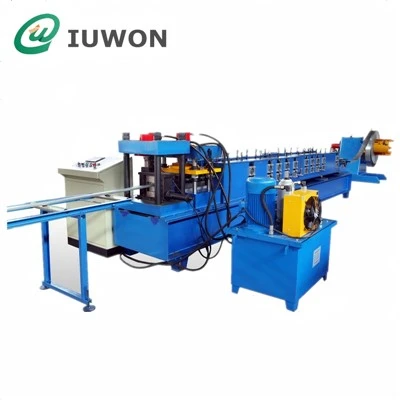
Let’s start with the basics, because misdefining these processes is where half the confusion starts. Press braking is a cold bending process that uses a hydraulic press and a set of custom-made dies to clamp a flat metal sheet or blank and bend it into a profile in one or a few strokes. Think of it like folding a piece of paper with a heavy stapler, but for metal: you place the flat sheet into the press, the die pushes down, and the metal bends along a single axis to create angles, channels, or simple profiles. Roll forming, on the other hand, is a continuous process that feeds a flat metal coil through a series of motorized, shaped roll dies—each pair of rolls bends the metal incrementally, gradually shaping it into the desired profile as it moves. It’s not a one-and-done bend; it’s a step-by-step transformation from a flat coil to a finished profile, in a single pass at high speed.
The biggest and most obvious difference comes down to how the metal is bent: press braking creates profiles by applying force at discrete points (usually one bend at a time), while roll forming bends the metal along its entire length gradually. But let’s dive deeper into the practical differences that matter for your bottom line, part quality, and timeline, because those are the ones that will actually change what you use.
First, profile length and consistency. Roll forming excels at long, continuous profiles—we regularly supply machines that make 100-foot gutter sections, 200-foot wall studs, or 500-foot roofing panels in a single run. Because it’s a continuous process, the entire profile is identical from end to end, with almost no variation in bend angle, thickness, or flatness. Press braking, by contrast, is limited by the size of your press and the weight of your blank. A standard press brake can handle blanks up to 12 feet long, and even the largest custom press brakes top out at around 20 feet. If you need a 30-foot beam for a stadium project, you either have to weld multiple press-braked sections together (adding labor and weak points) or switch to roll forming. Even within manageable lengths, press brakes have more variation: every bend stroke depends on operator setup, machine calibration, and even the temperature of the metal that day. We had a customer last year who used a press brake to make 20-foot window headers; their first run had a 1-degree angle variation from one end to the other, which made 400 of the 1,200 headers unfit for installation. A roll formed version of the same part would have a maximum angle variation of 0.1 degrees, no matter how long the profile is.
Next, material stress and part integrity—this is the mistake that engineer I talked to made earlier. When you bend metal, you stretch it on the outer edge of the bend and compress it on the inner edge. In press braking, that bending force is concentrated at the bend point, especially if you’re making tight bends or working with thicker material. That concentration of force creates localized stress, which is why he got those cracked channels. Roll forming spreads the bending force across the entire length of the profile, incrementally, so the stress is distributed evenly. For materials that are prone to cracking—like high-strength steel, aluminum alloys, or thin-gauge copper—roll forming is almost always the better choice. We worked with a solar panel mount manufacturer a few years back: they were press braking 10-gauge aluminum profiles, and 7% of their parts cracked during bending, leading to 15% scrap. Switching to a roll forming process cut their scrap to less than 0.5%, and even reduced the material they used, because they could work with thinner gauge aluminum that press braking would have broken. That’s not to say press braking is bad for stress: if you’re making simple, low-tolerance parts with thick, ductile steel, press braking can work fine. But for any part where crack resistance or structural integrity is key, roll forming’s gradual bending is a game-changer.
Then there’s tooling cost and lead time, which is a big factor for small to medium shops. Press braking dies are relatively cheap: a custom die for a C-channel in a 10-gauge steel might cost $200 to $500, and you can get it made in a few days. That makes press braking great for low-volume, custom jobs—like if you need 10 unique profiles for a small renovation project, you don’t want to drop $10,000 on a custom roll forming die that you’ll only use once. Roll forming dies, by contrast, are a big upfront investment: a complete set of roll dies for a complex profile might cost $8,000 to $50,000, and lead times are 4 to 8 weeks. But here’s the catch: once you have the dies, roll forming is almost free to run. The only ongoing cost is the metal coil and minimal maintenance, whereas press braking has higher labor per part because every bend has to be set up, and you’re limited to one bend at a time. For high-volume jobs—like making 10,000 roofing panels a month—roll forming can cut your per-part cost by 40 to 60% compared to press braking. Let’s do the math: if press braking a panel takes 5 minutes of labor and $2 in material, roll forming takes 30 seconds of labor and $1.80 in material. For 10,000 panels, that’s $17,500 in savings a year, even after you pay for the die. The break-even point for roll forming is usually around 5,000 to 10,000 parts; below that, press braking wins on cost, above that, roll forming is way more efficient.
Tolerance and complexity are another area where the two differ. Press braking is limited to simple, single-axis bends. You can make a U-channel, an L-angle, or a simple hat section, but if you need a profile with bends on two different axes (like a Z-shaped stud used in wall framing) or small, tight radii (less than the material’s thickness), press braking struggles. Making a Z-channel with a press brake requires two separate bends, which means two setups and more chance of error. Roll forming, though, can make complex multi-axis profiles in a single pass. We supply roll forming machines that make garage door profiles with 7 different bends, window frames with 5 different angles, and even custom rail profiles with indentations for fasteners—all in one continuous run, with tight tolerances up and down the entire length. The only time press braking beats roll forming on complexity is for very, very small parts—like 1-inch wide brackets. For small profiles, the size of the roll dies can be too small to function, so press braking is easier. But for most common construction and manufacturing profiles (2 inches wide and up), roll forming can handle way more complex shapes.
Finish quality is also a key consideration, especially for exposed profiles. Press braking can leave marks on the bend area from the die, especially if you’re using soft metals like aluminum. Those marks have to be sanded or polished, adding labor time. Roll forming, because it uses smooth, grooved rolls that support the entire profile as it bends, has almost no surface marks. The outer surface of the profile stays flat and smooth, which is perfect for gutter systems, fascia boards, or any other part that’s going to be visible to customers. We had a gutters installer who switched from press braking to roll forming because their press-braked gutters had die marks that showed up when painted, leading to complaints from homeowners. The roll formed gutters came out smooth, no extra finishing needed, and their customer satisfaction went up 25% in a year.
Of course, no process is perfect, and there are cases where press braking is still the right choice. If you have a very low-volume job (less than 500 parts) with simple shapes, a short timeline (you need it done in a week), or you’re working with a material that’s too thick for roll forming (over ¼ inch, usually—roll forming can handle thicker materials, but the dies get very expensive), press braking is the way to go. For example, if a contractor needs 20 custom L-brackets for a small deck, press braking is faster and cheaper than setting up a roll forming machine, which would require programming, die setup, and test runs.
As a profile roll forming machine supplier, I’ve learned that the best choice for any project isn’t about which process is “better” overall—it’s about matching the process to your specific needs. The contractor with the small deck job doesn’t need roll forming, but the solar panel manufacturer with 100,000 profiles a year does. The structural engineer with the 10-day deadline for roof frames chose press braking at first, which cost him 500 cracked parts. If he’d come to me before starting, I would have walked him through why roll forming for his 20-foot, high-strength steel C-channels would have cut scrap by almost 100%, and gotten his project done on time.

If you’re not sure which process is right for your next project, or you’re looking to upgrade your profile production to cut scrap, lower labor costs, and make longer, more consistent profiles, reach out to our team to discuss your specific needs. We can help you evaluate if a roll forming machine is a good fit, or work with you to adjust your process for your current jobs. Don’t let the confusion between roll forming and press braking derail your next project—let’s talk through the details to get you the right solution.
Solar Panel Frame Strut Roll Forming Machine References
- H. G. Nelson, Metal Forming: Fundamentals and Applications, 2nd Edition, McGraw-Hill, 2018.
- S. Kalpakjian, Manufacturing Processes for Engineering Materials, 6th Edition, Pearson, 2016.
- Profile and Roll Forming Association, “Key Differences in Metal Profile Manufacturing Processes,” 2022.
- W. C. Schofield, “Stress Distribution in Bending Processes: Roll Forming vs. Press Braking,” Journal of Manufacturing Science and Engineering, Vol. 139, No. 4, 2017.
Hanghzou IUWON Technology Co., Ltd.
Hangzhou IUWON Technology Co., Ltd. is one of the most professional profile roll forming machine manufacturers and suppliers in China. Please feel free to buy custom made profile roll forming machine made in China here from our factory. For price consultation, contact us.
Address: No.755, Xintangtou Village, Xinjie Street, Xiaoshan District, Hangzhou, Zhejiang
E-mail: sales@iuwon.com
WebSite: https://www.iuwonforming.com/
